
Graduation Ceremony Addresses
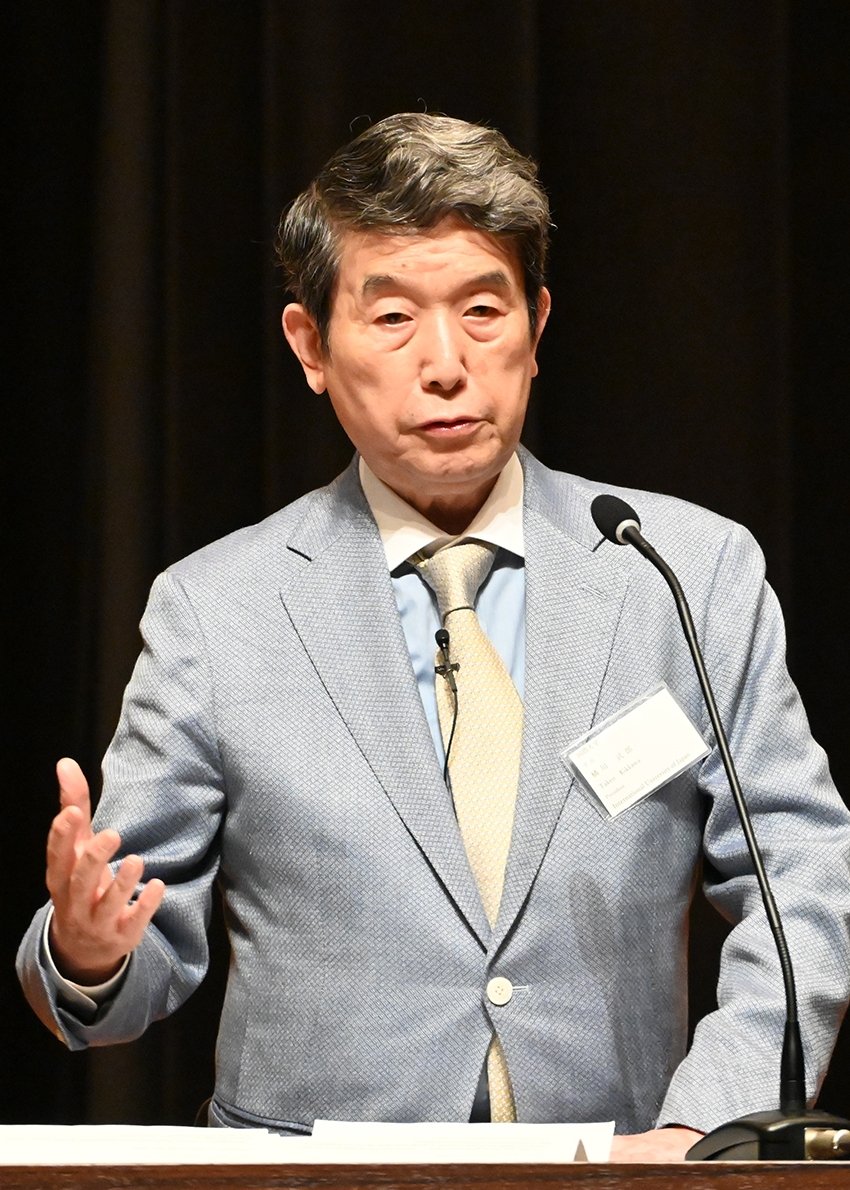
Takeo Kikkawa, IUJ President
Today, we have gathered here to celebrate the graduation of the Class of 2026 from the master’s programs and doctoral program at the International University of Japan.
I am pleased to announce that we are proudly sending off
- 115 Master’s students from the Graduate School of International Relations,
- 67 Master’s students from the Graduate School of International Management, and
- 1 PhD student from the Graduate School of International Relations.
I extend my heartfelt congratulations to all of you who have dedicated yourselves to your studies with such great passion on our Urasa Campus, surrounded by the rich natural beauty that evokes the traditional landscapes of Japan. In addition, I congratulate your families, whose encouragement and support have helped make this achievement possible. Let me also say that, as proud as you are of your own accomplishments, everyone here at IUJ is equally proud of what you have achieved.
Also, I would like to express my sincere gratitude to the families, scholarship sponsors, and local community members who have given their support to our students throughout their time at IUJ. The support of our scholarship sponsors and the Minami-Uonuma community has been invaluable in making IUJ a truly global learning environment. Thank you for your continued encouragement and partnership.
When we look around the world today, it is easy to lose hope. All we see is division and conflict. We hear countless words of hatred, and in some regions, violence and war continue to take innocent lives. At times, the future may appear uncertain and discouraging.
However, is this really the case?
Throughout history, humanity has repeatedly faced wars, crises, and challenges. Yet each time, people have found ways to overcome them and move forward. Today, more than eight billion people live on this beautiful planet. Together, human beings possess the ability to overcome divisions, solve problems, and continue towards building a better future.
So, what is necessary in order for us to do so? I believe that three things are important.
First, we must establish our own ideas based on accurate knowledge and express them. In other words, we must develop and demonstrate our own identity.
Second, we must listen carefully to others and recognize that different perspectives and values exist. This can also be described as acceptance of diversity.
Third, we must find solutions that maximize the combined satisfaction of all parties involved and put them into practice. This requires strong problem-solving skills and a willingness to cooperate.
During your time at IUJ, I believe you have strengthened all three of these qualities.
Our university is home for over 410 students from 62 countries and regions. Through living, studying, and learning from one another 24 hours a day, 365 days a year, you have learned how to express your own views, respect different perspectives, and work together to find solutions. These experiences are among the most valuable lessons that IUJ can offer.
IUJ is a truly “global place”. The people who will help solve the challenges facing our world are those who can combine a strong sense of identity, respect for diversity, and the ability to create solutions. They are the true global citizens who can bridge differences and build cooperation.
And those people are you.
Until today, our relationship has been that of teachers and students. From tomorrow, however, things will be different. We will become friendly rivals. What will we compete in? We will compete in how well we express our identity, embrace diversity, and put our solution-building abilities into practice. Put simply, we will compete in who can live the most meaningfully and admirably.
As for me, I know that my remaining years are limited. Even so, I intend to make the most of them and live them as admirably as I can. So don’t expect me to lose this competition too easily.
Someday, somewhere in the world, I sincerely look forward to meeting you again—not only as graduates of IUJ, but as good rivals and good friends.
Once again, congratulations to the Class of 2026, and my best wishes to you all.
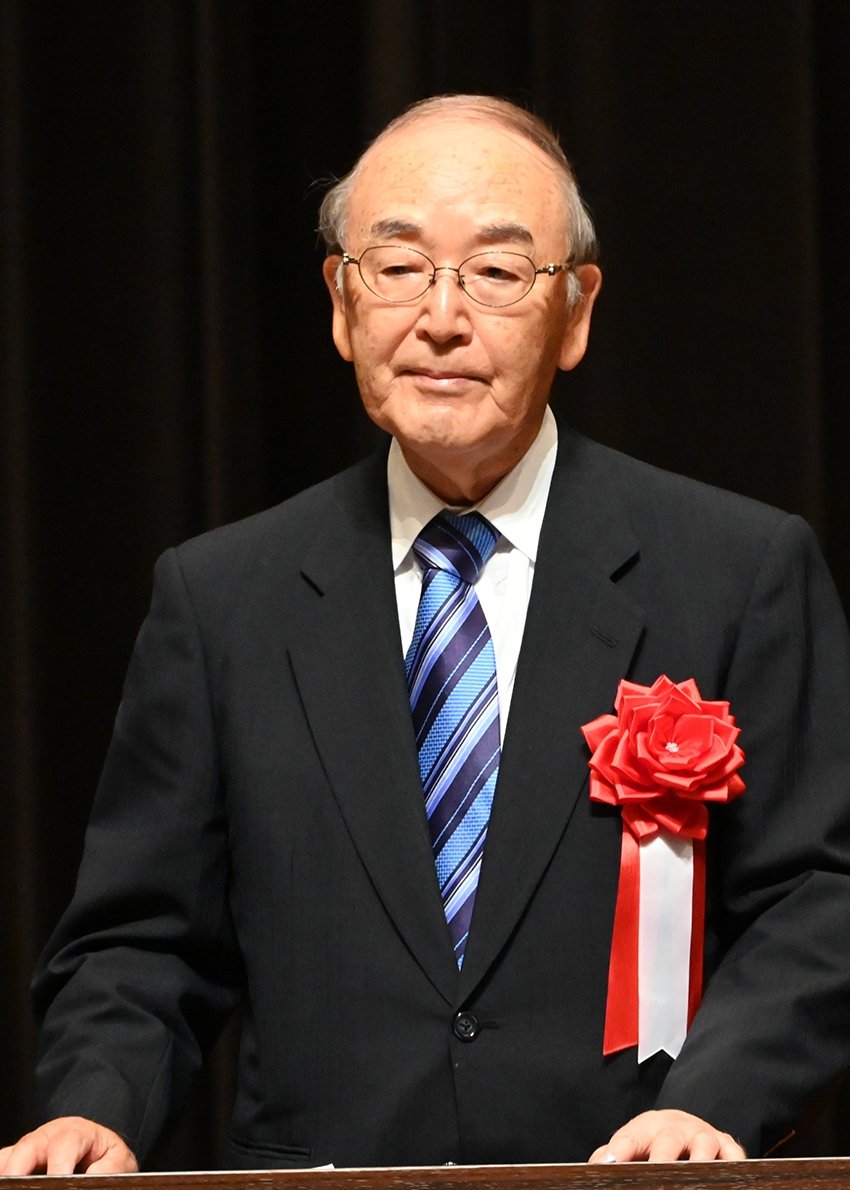
Mr. Akio Mimura
Honorary Chairman, Nippon Steel Corporation
Honorary Chairman, The Japan Chamber of Commerce and Industry
Thank you for the kind introduction. I am truly honored to be with you at your commencement.
Today, I would like to speak about what I have learned in my 60-year business career, 51 years at Nippon Steel Corporation, and nine years at the Japan Chamber of Commerce and Industry. My life is, of course, my own unique, personal life. However, I believe the lessons I’ve learned have something you can share.
As my place of employment, I chose Fuji Iron & Steel, a steel manufacturer ranked second in the industry, because I hoped to contribute to the development of the Japanese economy and I assumed they would have the dynamic energy of trying to catch up to and pass the No. 1 manufacturer.
In my seventh year after joining, however, Nippon Steel Corporation was born through a 50:50 equal merger between Fuji Iron & Steel and the No. 1 Yawata Steel, so my plan of passing the No. 1 steel manufacturer fell through straightaway. Later, Nippon Steel Corporation merged with the No. 3 and No. 5 manufacturers. Mine was a corporate life where I experienced first-hand the consolidation and restructuring of the Japanese steel industry that was essential for ensuring international competitiveness.
Synergistic effects cannot be achieved simply by merging. Positive effects can only be fully realized when personnel and equipment are optimized through post merger integration or “PMI.”
In the 50:50 merger of the Nippon Steel Corporation, it was extremely difficult to execute major staff reductions and large-scale shutdowns of equipment.
However, due to the 1985 Plaza Accord, the yen exchange rate appreciated from 240 to 120 yen per dollar. There was a sudden loss of export competitiveness, resulting in a steep drop in export volume. Export industries like automobiles and shipbuilding requested large price cuts from us, and the annual profit of Nippon Steel Corporation was forecast to be a loss of 100 billion yen. The sudden rise in the yen, compounded with the delay of PMI, made major cost cutting an urgent issue.
A committee made up of 14 directors was hurriedly formed, and I was appointed head of the secretariat. Thus I was able to directly experience the entire course of the fierce debate. The resulting streamlining plan was formulated around two key points:
- First “Fixed costs will be reduced by 40%, including shutting down five medium-sized blast furnaces out of 12, blast furnaces being the key equipment in the industry.”
- Second “Employees will be reduced by 75% from 68,000 to 17,000. However, there will be no layoffs. All means shall be exploited to secure work for ex-employees, such as creating new businesses or transfering them to related companies, and reducing the number of new graduates hired. Full consideration shall also be given to employee departure conditions.”
It was a large-scale streamlining plan unparalleled anywhere in the world. This streamlining was all carried out according to plan. I learned three lessons from this experience.
First, Major changes in the environment are a good chance for organizational renewal. In any organization, you experience a diverse range of incidents, including severe equipment accidents, and compliance violations. If you want to implement bold restructuring, and the execution is difficult for some reason, you should promote the intended restructuring by actively making use of such accidents and major economic fluctuations. The most important role of a top manager in restructuring is aligning the crisis consciousness among everyone involved. If a major incident occurs, the incident can play that role for you.
Second, The approach we adopted was “streamlining with no sacred cows,” where no fields are treated as exceptions. Our aim was to attain speed and size of cost reduction. However, every organization should have some sacred cows. In the manufacturing industry, these are: investment for maintaining product quality and ensuring work safety. However, if identification of sacred cows is debated, it will consume a huge amount of time. The next-best option is to first proceed with across-the-board streamlining, and consider sacred cows later. If cost reductions in the sacred cow areas can be reversed, that is the end of the plan.
Third, I learned the correctness of the personnel evaluation maxim: “It takes three years for a superior to understand a subordinate, but only three days for a subordinate to understand a superior.” By observing a fierce debate of 14 directors from subordinate position, I keenly realized the correctness of that saying. Some directors may routinely act self-important yet constantly make unpersuasive comments, while others may usually be quiet yet make strong points that command people’s respect. I value these words as a reminder to keep myself in check.
I served as President and Chairman of Nippon Steel Corporation, and then took the opportunity of the merger with Sumitomo Metal, to retire from the Chairman post. This ended my 51-year career in the steel industry. People often say: “Have dreams, and work persistently and hard to achieve them.” I think that is a wonderful thing, but achieving that requires three things: talent, financial background, and good luck. My life has been a series of steps that amounted to “first climbing the hill in front of me.” When you climb the hill, you can see a wider world. Then you climb the next hill, and you can see an even wider, bigger world.
For me, my time as president was the most exciting, and I felt a real sense of purpose. I tell my younger colleagues: any sort of organization will do. Aim high. There will be many tough times, but also much joy. In the end it’s a position worth devoting your life to.
Through a turn of fate, I was appointed as Chairman of the Japan Chamber of Commerce and Industry in 2013. The members of the Chamber are 1.25 million mainly small and medium-sized enterprises who make up about one-third of the 3.8 million firms in Japan. Its mission is to develop the Japanese economy by boosting the dynamism of small and medium-sized firms. Looking back, the greatest reward I received during my nine years as Chairman, was encountering the ideas of the great Eiichi Shibusawa, first Chairman of the Tokyo Chamber of Commerce.
He is called the “father of Japanese capitalism,” and was involved in founding 481 companies and about 600 public institutions in the early days of Japanese capitalism. After the Meiji Restoration in 1868, Japan took steps toward full-fledged modernization. It was the only one non-Western country that successfully modernized while not being colonized and maintaining its national identity. In the book he dictated, The Analects and the Abacus, he describes his management philosophy like this:
“When I consider founding a business, I think about whether that business is ethically correct. Next, I think about whether it will be useful for the development of society. If the contribution to social development is large, then even if the profit is small, I believe we should move forward with that business.”
This thinking of his—balancing private and public interests—is widely shared in the Japanese business world today, and I too am a strong supporter. Like all great philosophies, it is easy to say but very difficult to practice. However, throughout his 91-year life, Shibusawa demonstrated that such balance is possible.
Three years ago, I finished my 60-year business career . Up to now, I led a life that advanced in a straight line toward each goal, but from now on I want to spend more relaxed days choosing my own way, and taking in the sights around me. Needless to say, communication is extremely important in business. To wrap up my talk today, I would like to present to you points that I have put into practice for smoother communication.
First, I want to emphasize the importance of speaking in an easy-to-understand way, in your own words. Before I became president, I requested one-to-one 30-minute meetings with about 20 prominent company presidents. One of the people I met was President Chumphon of Thailand’s Siam Cement. He told me: “Japanese managers tend to say easy things in a way that sounds difficult. Mr. Mimura, please say easy things in an easy-to-understand way.”
I decided to become a president who would speak in an easy-to-understand way, in my own words. Partly as a way of keeping myself in check, I declared that aspiration at my first press conference as president. However, this too is easy to say, but hard to do. If you don’t understand things clearly yourself, you can never speak in your own words.
Second, I want to emphasize the importance of asking good questions. A good question is one from a new perspective, or one which adopts a more fundamental viewpoint, or one based on the accepted perspective of society rather than the assumptions of your own organization. Daily study and consistent effort are essential, and you have to create opportunities to step away from the company mindset and connect with the perspective of the broader society.
A good question livens up a meeting, elicits even better questions, and brings about better results. For a presenter, good questions can be taken as a reward for the presentation.
You are, quite literally, about to embark on an uncharted voyage. Among the innumerable policies that President Trump is rolling out, some will take root as new global trends, and others will be fleeting and fade away. What will the development of AI bring to society? And how will geopolitical trends shape the world order? No one knows for certain. However, one thing for sure is that an era has arrived where young people who tackle challenges can and should thrive the most. I’ll conclude this address with my heartfelt wishes that you all have the best of luck in the stimulating lives ahead of you.
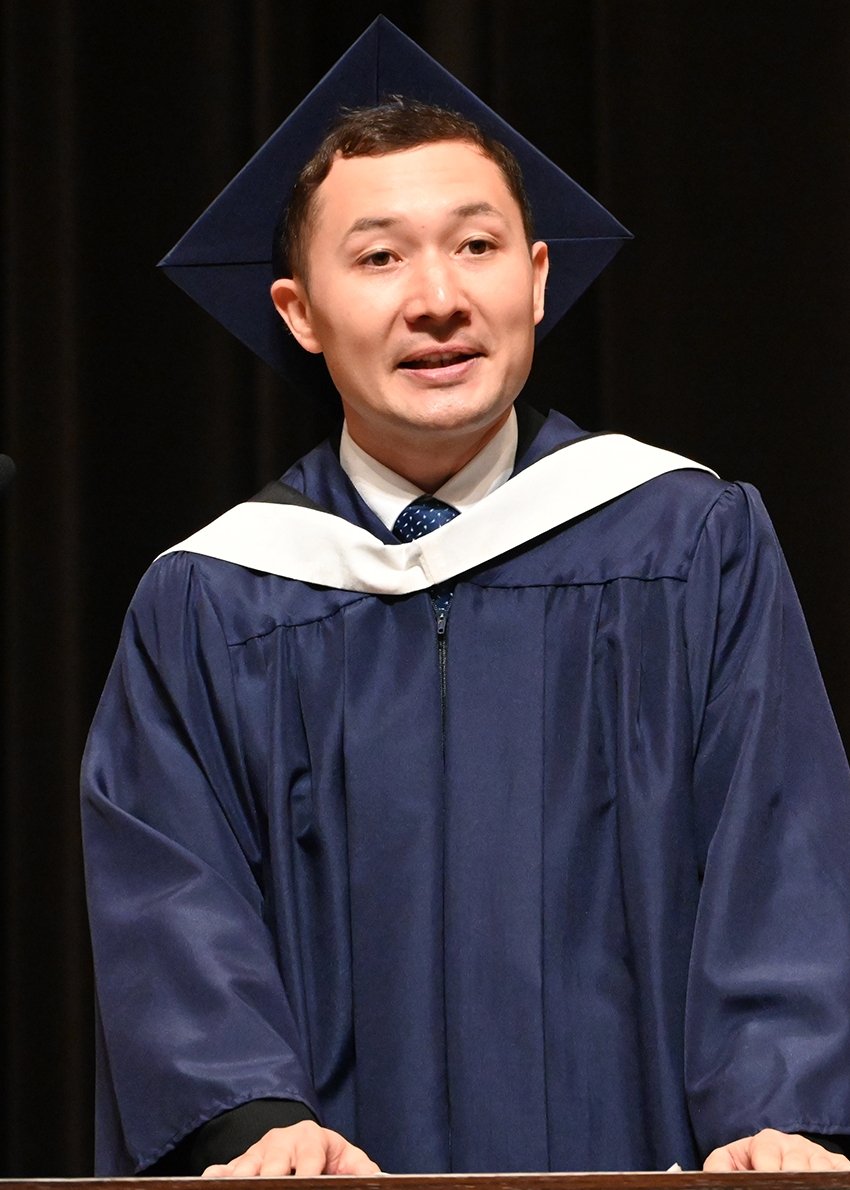
Muslimov, Mukhammadjon Marat Ugli,
GSIR Valedictorian
Your excellencies, honorable guests, the Chairman of IUJ, President Kikkawa, the Deans of GSIR and GSIM faculties, respected professors, staff, all the families, friends, kohais, senpais, everyone who is watching us online, and the stars of today – the Class of 2026:
Good afternoon to you all!
My name is Mukhammadjon, but everyone knows me as MJ. I come from Uzbekistan, and it is both an honor and a privilege for me to give a speech here as the valedictorian of the GSIR Class of 2026.
When I came to IUJ in July 2024, I fell in love with this place, and since then my love has gotten stronger and stronger. Beautiful autumn with golden leaves, a severe winter with three meters of snow, a gorgeous spring with sakura in full bloom, and a summer covered in shades of green – this is the beauty of Minamiuonuma and Japan itself.
But IUJ is much more than its beautiful surroundings. It is the place which connects people from different nationalities, cultures, beliefs and backgrounds. Here, we have learned to become more patient, open minded, and tolerant, questioning things that we once considered as unquestionable.
Those long nights spent in study rooms and the library, preparing for exams in Statistics, Econometrics, and Macroeconomics, were not easy. There were moments of stress, frustration, and exhaustion. But every sleepless night, every challenge, and every sacrifice has brought us to this moment – a moment when we can all proudly say: “We finally did it”.
The social life in IUJ was one of the most memorable parts of this journey: losing count of how many times we fell on our first ski day, competitive spirit in the house games, concerts with my beloved IUJ band, games and gatherings in SD3-lounge, parties and karaoke-nights at CNP, and watching sunrise at the rooftop with friends, are just a few of the memories that come to my mind. These moments may seem small, but they are the ones that turned strangers into friends, classmates into family, and a university into a home.
Dear fellow graduates. Everyone knows that no one succeeds alone. Behind every achievement stands the support, guidance, and encouragement of many people. And today I want to express my gratitude to our professors who have shared their knowledge, wisdom, and experience. In particular, I would like to thank my supervisor professor Ariyoshi, as well as professor Huang, Professor Kane, Professor Jinnai, Professor Wong, Professor Hua, Professor Chow from GSIM, Professor Mondejar, Ishibashi sensei, and all other professors who have guided us on this journey.
Studying in Japan was a dream for me, and I would like to thank the Japanese government and my scholarship sponsor JISPA-IMF, especially Ozgur Demirkol and Saika-San for giving me this opportunity and support throughout these two years.
Also, I want to thank the staff of IUJ, including teams of OAA, OSS, OGA, PR, MLIC, Dorm staff, bus drivers, cafeteria staff, and cleaning staff, whose efforts made our daily lives easier. Thank you for your dedication, kindness, and service. Arigato gozaimashita (bowing).
I was also honored to work in IUJ as TA, facilitator, and a member of the IR Council, and I would like to thank each of you who helped me succeed and serve the IUJ community.
Now, I want to express my special gratitude to the people, whose love, sacrifices, and support has shaped the person standing in front of you today. Of course, I am talking about my parents. Every achievement I have reached is built upon their sacrifices, encouragement, and belief in me. I am sure they are watching us online, and I want to send them a special message in Uzbek language: “Adajon, Oyijon Assalomu aleykum. Hammasi uchun Rahmat”. Thank you for everything, you are my heroes.
There is one more person I would like to thank from my heart – my son, Mansurjon. Although he may be too young to fully understand what this day means, I want him to know that everything I do is inspired by my hope to make him proud and to create a better future for him.
Last but not least, I want to express my sincere gratitude to all my IUJ friends, with who I shared these incredible two years. In particular, I would like to thank the Uzbek community, including Elyor aka, Jamshid aka, Muhammadjon aka, Farruh aka, Azamat, Ilyos; my study partners, Abhijeet and Ash, with who I prepared for exams; my colleagues from the IR council Fatima and Joyce; my fellow IUJ music club members Arry, Rachman, and Windhu, my close friends Akylbek, Janani, Daisy, and Hafsa; my super-senpais Amro Baroma and Muhammad Nauman Mustafa; my kohais Sebastian, Miko, and Jed; and all the members of the Volleyball Club and Kobayashi house for the unforgettable memories we all shared together.
Finally, my gratitude goes to all of you – the Class of 2026. Thank you for the memories, friendships, and for the time we spent together. I wish each of you the very best in your life.
One of the most important lessons I have learned is that you do not have to be the most talented, the smartest, or the best to achieve your dreams. Courage, hard work, and dedication can take you further than you ever imagined.
To all IUJers I wish good luck and success in life, Thank you very much and Arigato Gozaimashita.
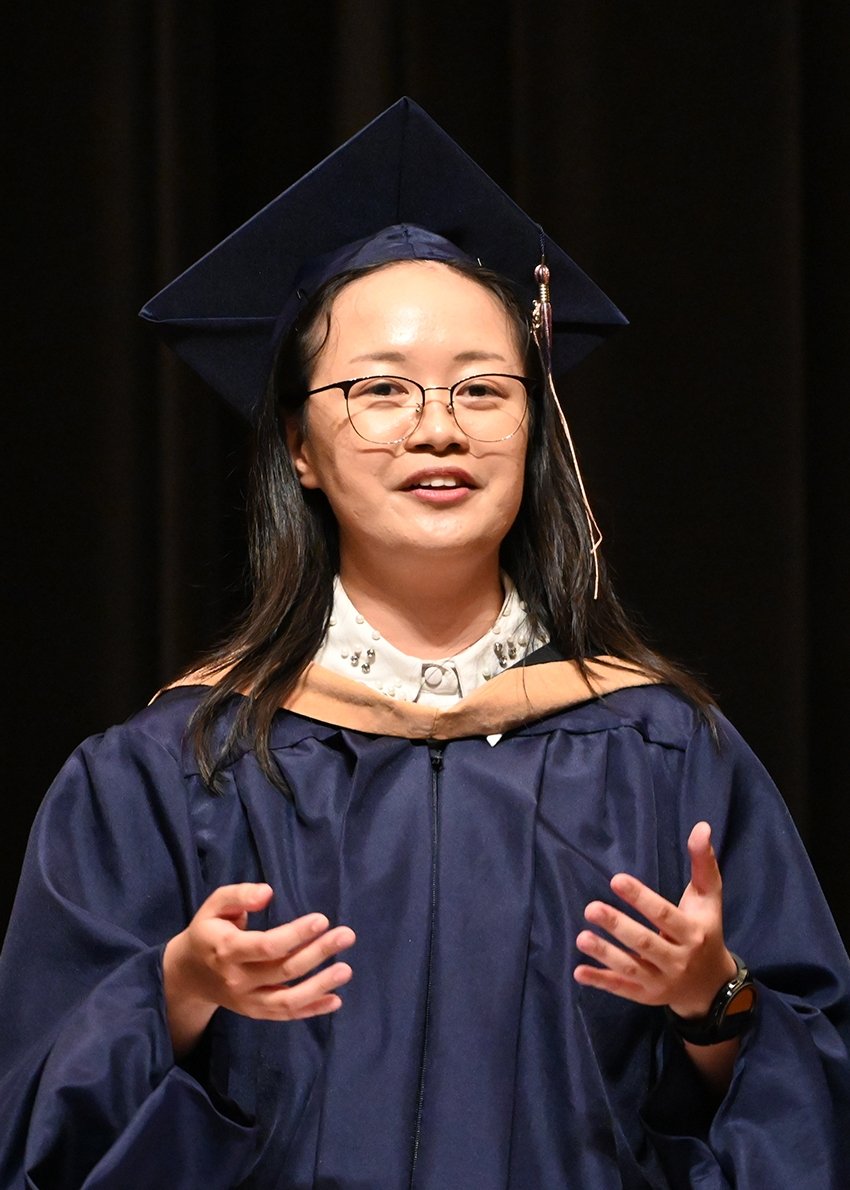
Siman, Deanne Narvaez
GSIM Valedictorian
A pleasant afternoon to our esteemed guests, professors and school personnel, family and friends both in this hall and online.
To the Class of 2026, a heartfelt congratulations to everyone’s achievement, and for gracefully bringing our graduate student life to a close.
Like many of you, I arrived at IUJ with two suitcases and one mindset of “hope-for-the-best.”
Now, we are leaving with an unbelievable amount of learnings, stories, and friendships that will last years, hopefully decades to come.
On this last day, let us take this opportunity to show our gratitude and appreciation, first to our professors, who have gone through great lengths to impart their expertise on each of us.
I would like to give special thanks to my research supervisor, Professor Chuang, as well as to our Japanese language program professors for your valuable guidance.
Our sincerest thanks to the OSS, OAA, OACS, MLIC team, OGA, and the entire school administration team for guiding us on virtually every concern we’ve had both inside and outside of academic life.
This journey has been possible through MEXT, and I take this opportunity to express our gratitude to MEXT for granting opportunities to students like myself.
Of course, this weekend may be our last chance to say thank you to our classmates, our friends and local community members, who have, in each of their own ways, made IUJ life exciting and undoubtedly memorable.
To the Filipino community in IUJ, I am beyond blessed to have experienced this era of my life at the same time as each of you.
Finally, a huge thanks to our families, who cheered for us every step of the way as we explored life’s uncertainties miles away from home.
Now, I know each of us has our own ideas about what makes IUJ life uniquely IUJ, what will come to mind when we're old and telling stories, and my take is this.
In IUJ, we are a part of each other’s growth story.
The amount of effort you gave to every subject, every project, enabled you to thrive here regardless of your professional background.
We witnessed each other improve day by day, slowly but surely, with some things you had to learn from scratch, just so you could bring something to the discussion.
I hope you give yourself credit for the things that you struggled with before, because you are able to do those things now with so much ease and confidence.
As we move forward, we bring with us a sum of all these moments—
every moment of happiness when you achieved something you really wanted,
every episode of heartbreak from not attaining what you genuinely put your effort in,
and the hope that there are countless opportunities that will come your way in the future, because you are so much more capable now than you in the beginning.
IUJ life has been, in unexpected ways, a dream come true, and the answer to the prayers I never said out loud.
もう少しIUJの生活を楽しみたいですが、私たちは前に進まなければなりません。ですから、私たちがこの2年間で成長したことを信じて、新しい目標に向かって頑張りましょう。
In more detailed English, as much as we wish to enjoy these moments a little longer,
time will not wait and we have to move forward.
With this, wherever our next destinations may be after IUJ, let’s all chase our new dreams, while remembering that we have emerged stronger through every hardship and every success from the past 2 years.
Thank you for giving us, I quote, not the master's experience that we expected, but the one we truly needed. ありがとうございました。